

Wagyu Beef Grading – What Does It Mean?
The legendary reputation of Japanese Wagyu beef with its exceptional quality, tenderness, rich and buttery flavor, has captured the heart and palates of the meat connoisseurs in the capital, and while finding this quality of meat has gotten much easier to find in upscale restaurants in Jakarta, understanding the wagyu grading system as still be quite daunting. We have this guide to help you choose the quality of your Wagyu cut and ensure every bite is worth it!
Before a cut of Japanese Wagyu is bestowed its prestigious grade, meticulous measurements and assessments are conducted to ascertain its quality. The grading of Japanese Wagyu beef is marked by a letter and a number, signifying both yield and quality.
The letter ranges from A to C, with A representing the highest level of excellence. Yield grade ‘B’ is considered standard, making grade ‘A’ often a prize sought after by discerning enthusiasts. This grading is determined by calculating the percentage of meat, fat, and bone within the cattle, with larger animals often yielding superior-quality meat. It’s only after the beast meets its fate that the true quality of its beef is revealed, marked by the awarding of a grade number, from 1 to 5, with 5 being the highest point.
Quick Summary
- Japanese Wagyu is evaluated using two components: a yield grade letter (A–C) and a quality grade number (1–5), with A5 being the highest possible combination.
- The BMS (Beef Marbling Standard) is the heart of Japanese Wagyu grading, scored on a scale of 1–12. To achieve an A5 qualification, a minimum BMS of 8 is required.
- Australia uses the MB (Marbled Beef) system on a 0–9+ scale, which operates similarly to the Japanese BMS, but groups its highest scores under the 9+ category (equivalent to Japan’s BMS 10–12).
Types of Wagyu Beef
Before diving into the complex grading numbers, it helps to see the big picture. While “Wagyu” literally translates to Japanese cattle, this premium beef is now raised globally. The location and genetics dictate not only the meat’s profile but also how it is graded.
Japanese Wagyu is the purest form, known for its extreme, buttery marbling. Outside of Japan, countries like Australia and the United States have become major players. Australian and American Wagyu are predominantly crossbreeds, pairing Wagyu genetics with robust breeds like Angus. This crossbreeding is deliberately designed to balance the legendary Wagyu melt-in-your-mouth texture with a stronger, more traditional beef flavor.
Because these origins produce distinctly different meat profiles, they rely on their own specific grading systems to measure quality. Let’s break them down.
How is Japanese Wagyu Beef Graded?
If you’re used to U.S. beef grading like USDA Prime or Choice, get ready for something a little more precise and luxurious when it comes to Wagyu beef. In Japan, where the Wagyu grading system originated, beef is graded with two components: a letter and a number. Together, these give you a detailed snapshot of the meat’s yield and overall quality.
Let’s break it down into the two key parts: Yield Grade and Quality Grade.
1. Yield Grade: How Much Usable Meat You Get
The letter in the Wagyu grade (A, B, or C) refers to the yield grade, which tells you how much saleable meat can be obtained from a particular cow. It’s all about efficiency and how much meat you can expect once the cow is processed.
Here’s what each letter means:
- Grade A – More than 72% yield: This is the top-tier yield grade, meaning you get a high percentage of usable meat. Think of it as “more steak for your buck.”
- Grade B – Between 69% and 72% yield: This is the standard yield grade—still very good, but not quite as high as Grade A.
- Grade C – Less than 69% yield: Below standard, meaning less meat is extracted compared to other grades.
This part of the grading considers factors like:
- Ribeye area
- Thickness of short ribs
- Subcutaneous fat (the outer fat layer)
- Half-carcass weight
So, when you see an A5 Wagyu, the “A” means you’re getting an excellent meat-to-cow ratio—premium value and efficiency.
2. Quality Grade: The Look, Feel, and Taste of Luxury
Now, onto the number part of the grade—this is where the real indulgence lies. Wagyu’s quality grade ranges from 1 to 5, with 5 being the absolute best in terms of flavor, marbling, color, and texture.
This grade is based on several mouthwatering factors:
- Beef Marbling Score (BMS): This measures the fat interwoven with lean meat. Wagyu is famous for its rich marbling, which gives it that buttery, melt-in-your-mouth quality. The higher the BMS (up to 12), the more luxurious the steak.
- Beef Color Standard (BCS): Meat color should be balanced—not too pale, not too dark. Middle-of-the-road coloring is ideal.
- Beef Fat Standard (BFS): The fat in high-quality Wagyu should be glossy and creamy white, not dull or yellowish. Glossy fat usually means it’s going to melt beautifully when cooked.
- Firmness & Texture: Top-grade Wagyu should feel firm to the touch but tender when you take a bite. The texture should be fine and consistent, with fat evenly distributed—not clumped up or stringy.
Here’s how the quality grades break down:
| Grade | Description |
| 5 | Extremely Good |
| 4 | Very Good |
| 3 | Average |
| 2 | Below Average |
| 1 | Poor Quality |
So, that legendary A5 Wagyu? It means you’re getting beef with the highest possible yield (A) and top-tier quality (5)—the crème de la crème of steaks. On the flip side, something like a C1 would be much lower in both usable meat and quality.
Understanding BMS: The Heart of Japanese Wagyu Grading
BMS stands for Beef Marbling Standard, the single most critical factor in determining both the grade and the price of a Wagyu cut. Graders from the Japanese Meat Grading Association (JMGA) evaluate the ribeye cross-section by comparing it to standardized reference photographs, then assign a score from 1 to 12.
In practice, BMS 1 and 2 show almost no marbling and are rarely considered in Wagyu grading, making BMS 3 the effective starting point. At the other end of the scale, a BMS 12 cut appears almost white, with lean muscle visible only as thin threads within a dense matrix of intramuscular fat.
Here’s a quick breakdown of how each tier translates to the plate — along with the corresponding quality grade:
| Grade | BMS Range | Description |
| 5 | 8–12 | Extremely Good |
| 4 | 5–7 | Very Good |
| 3 | 3–4 | Average |
| 2 | 2 | Below Average |
| 1 | 1 | Poor Quality |
- BMS 3–4: A solid entry into the Wagyu world. Noticeably more tender and flavorful than regular beef, but without the full-on richness that defines premium Wagyu.
- BMS 5–7: The range where buttery texture and beefy flavor start to sing in harmony. Creamy mouthfeel, well-distributed fat, and still satisfying in a full steakhouse portion.
- BMS 8–9: This is where A5 territory begins. The fat-to-lean ratio is dramatically high — intensely rich and genuinely melt-in-your-mouth.
- BMS 10–12: Ultra-premium. The eating experience is so concentrated in richness that a 60–90 gram portion is genuinely all most palates can comfortably handle at once.
One important note: for A5 certification, the BMS must be 8 or higher. But since both BMS 8 and BMS 12 technically qualify as “A5,” always ask for the specific BMS score — not just the letter grade — when purchasing premium Wagyu.
How is Australian Wagyu Beef Graded?
Australia is one of the biggest players in the Wagyu world outside of Japan, and they’ve developed their own grading system that takes its cues from Japan’s — with a few key differences.
Marbled Beef (MB) – Scale 0 to 9+
Australia uses the AUS-MEAT grading system, where marbling is measured using a scale called the Marbled Beef (MB). This scale runs from MB0 (no intramuscular fat) all the way to MB9+ (extraordinary amounts of marbling), in increments of 1.
The “9+” designation is worth noting: while scores equivalent to BMS 10, 11, and 12 do exist in Australian Wagyu production, they are all grouped under the MB9+ label. According to the AUS-MEAT system, the average premium Australian Wagyu sits between MB3 and MB7, while the highest-graded cuts reach MB8 to MB9+.
It’s also worth knowing that to be labelled and exported as “Wagyu” in Australia, beef must contain at least 50% Wagyu genetics. Labels like “F1,” “Purebred,” or “Fullblood” indicate how close to pure Wagyu genetics the animal is — with Fullblood being the highest, and F1 representing a 50/50 crossbreed, typically with Angus.
MB vs. BMS: How Do They Compare?
The short answer: they’re closely aligned, but not identical at the top end.
The Australian MB score and the Japanese BMS scale work in a very similar way — an Australian MB5, for example, corresponds to a BMS 5 in Japan. The divergence happens at the upper range: while Japan’s BMS goes all the way to 12, Australia’s scale caps at 9+, which roughly corresponds to BMS 11–12 on the Japanese scale.
What this means in practice: an Australian Wagyu at MB8 or MB9+ can deliver a comparable eating experience to Japanese A5 Wagyu at the higher BMS levels — rich, buttery, and intensely marbled. The main differences tend to come from breeding practices and feeding programs, which influence both marbling levels and the fat’s overall flavor profile.
Other Factors in Wagyu Quality
The grade number tells you a lot — but it doesn’t tell you everything. Several factors outside the grading system significantly influence what ends up on your plate.
1. Feed
What a Wagyu cattle eats directly shapes the quality of its fat. Premium Japanese Wagyu cattle are typically finished on a carefully controlled grain diet for an extended period — sometimes 600 days or more — which produces the characteristic white, creamy fat that grades so highly. In Australia, cattle may be raised on a combination of grass and grain programs, resulting in slightly different fat color and flavor profiles. Grass-finished Wagyu tends to produce yellower fat due to higher beta-carotene content, which grades lower under Japanese standards regardless of marbling level.
2. Lineage
Genetics are the foundation. The Japanese Black breed (Kuroge Washu) — which accounts for over 90% of Wagyu raised in Japan — has the highest genetic potential for intramuscular fat deposition of any cattle breed in the world. That’s why it dominates the high-BMS categories. Crossbred Wagyu (like much of Australian and American Wagyu) inherits some of this potential, but the marbling ceiling is generally lower than that of Fullblood or Purebred cattle.
3. Expert Preparation
Even the finest A5 BMS 12 steak can be let down by the wrong cooking technique. Because Wagyu fat has a lower melting point than conventional beef, it behaves very differently under heat. Prolonged high-temperature cooking can render out too much fat, leaving the meat greasy rather than luscious. For high-BMS cuts, a quick, controlled sear is often ideal — and portion size matters just as much as technique.
Understanding the grading system is one thing, but tasting a perfectly balanced Wagyu is another. The ultimate dining experience comes from finding the ideal harmony between the rich, buttery fat of Wagyu and a robust beef flavor that you can enjoy from the first bite to the last.
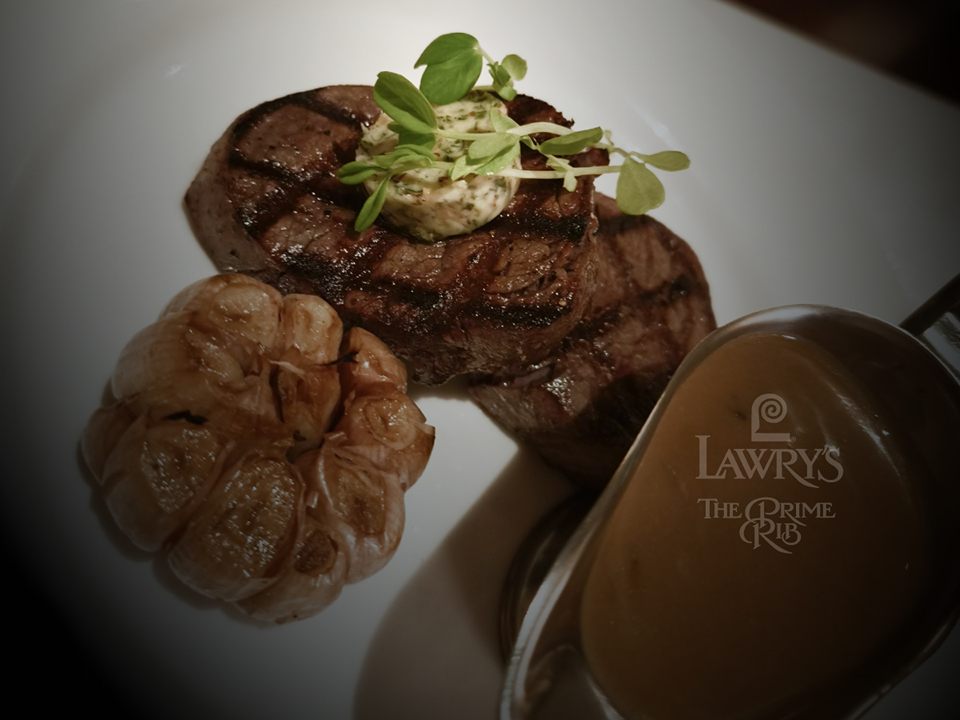
At Lawry’s The Prime Rib Jakarta, the Wagyu is meticulously sourced to hit this exact perfection. To experience this exquisite balance, consider trying Lawry’s Wagyu MB7 Sirloin, which offers an exceptional level of marbling for an intensely flavorful steak, or the Wagyu MB5 Filet Mignon, the perfect marriage of the filet’s natural tenderness enhanced by rich, buttery notes.
Savor the sublime tenderness of this premium Australian Wagyu by booking your seat, or explore Lawry’s menu for more tantalizing options.
FAQ
The letters (A to C) represent the yield grade, with 'A' being the highest quality, indicating a higher meat-to-bone ratio. The numbers (1 to 5) reflect the meat’s quality, where '5' signifies top-tier quality based on marbling, color, and firmness
The MB (Marbled Beef) score, ranging from 4/5 to 8/9, measures fat content. Higher scores mean more marbling, resulting in richer flavor, tenderness, and a buttery, melt-in-your-mouth experience.
Besides marbling, judges assess the color of lean meat, the glossiness of fat, and the firmness of the beef, all of which contribute to Wagyu’s premium quality and texture.
Based on the wagyu grading concept, A5 is better than A1. Therefore, A5 wagyu costs more per pound than A1 wagyu.

Reserve Table
Lawry’s Restaurants is the perfect place to begin your venue search for any occasion.